Benefits of In-Home ABA Therapy: What Learning at Home Can Offer

Quick answer
The main benefits of in-home ABA therapy are that your child learns in a familiar place, practices skills during the real routines where they are needed, and has family members nearby to learn the same strategies. Home sessions can also make it easier for skills to carry over into daily life and can reduce travel. Results vary, and the right plan depends on your child's goals.
In-home ABA therapy brings learning into the place your child knows best. The biggest benefits are comfort, practice during real family routines, and the chance for parents and siblings to learn the same strategies the therapist uses. Because skills are taught where they are actually needed, they often carry over into everyday life more easily. Results vary from child to child, so the setting should always match your child’s goals.
Key takeaways
- Home is familiar, so many children settle in and start learning with less stress.
- Skills like dressing, mealtime, and play are practiced in the exact routines where they happen.
- Parents can watch, ask questions, and practice strategies during sessions, not just hear about them later.
- Siblings and other family members can join in when it fits your child’s goals.
- In-home ABA still needs a plan for using skills in new places and with new people.
What is in-home ABA therapy?
Applied behavior analysis (ABA) is an approach that teaches skills by looking at what happens before and after a behavior, then using that information to support learning. The CDC describes ABA as a notable behavioral treatment for autism. If you are new to ABA, our guide on what ABA therapy is covers the basics.
In-home ABA simply means sessions take place at your home instead of a clinic. A Board Certified Behavior Analyst (BCBA), a graduate-level certified clinician, designs and oversees your child’s plan. A Registered Behavior Technician (RBT), a certified paraprofessional, usually works directly with your child. The BACB notes that RBTs practice under the direction and close supervision of a qualified supervisor.
If you are still deciding between settings, our center-based vs. in-home ABA comparison walks through the trade-offs side by side. This article focuses on what home sessions can offer once you are leaning that way.
Why does a familiar environment help some children learn?
New places can be a lot for any child. Unfamiliar sounds, lights, rooms, and people take energy to process. For many autistic children, a familiar setting means less to adjust to and more energy left for learning.
At home, your child already knows where the snacks are, which chair is theirs, and where favorite toys live. The therapist can use those familiar things to build trust in the first sessions. This early step is often called pairing, which means the therapist becomes linked with fun and good things before asking much of your child.
Comfort is not the same as no challenge. Some children see home as free time and need a little support switching into learning. A predictable start to each session, like a short visual schedule, often helps. The NICHD notes that many people with autism respond best to structured programs, and structure can be built into a home just as well as a clinic.
How does in-home ABA build skills inside real routines?
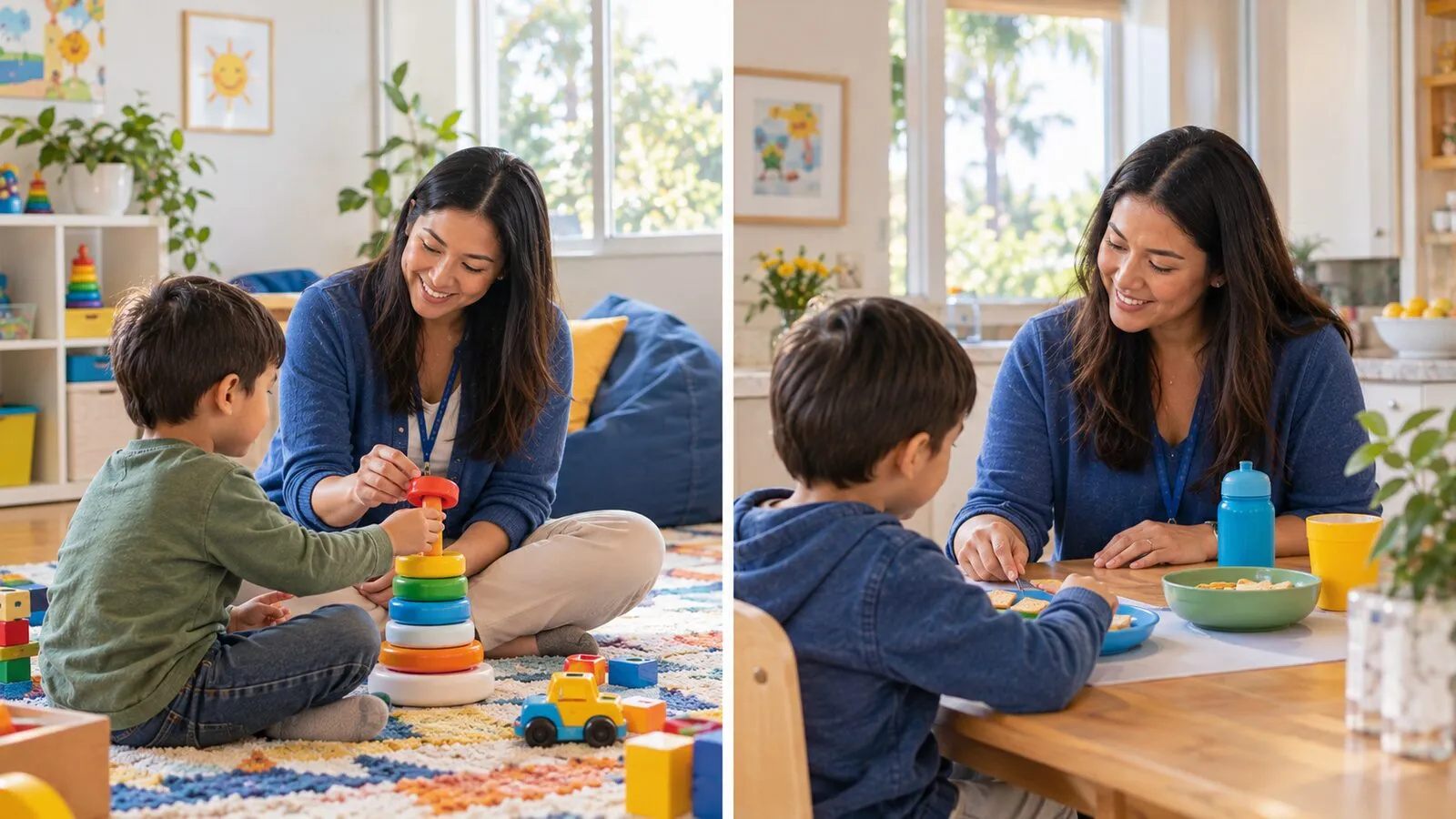
Many goals families care about most are tied to home life. Getting dressed, brushing teeth, sitting for dinner, playing with a sibling, and settling at bedtime all happen at home. In-home ABA lets the therapist teach those skills in the actual bathroom, kitchen, and bedroom where they occur.
That matters because the details of a routine are part of the skill. Your child’s toothbrush, your sink height, and the order your family does things all shape how the routine goes. Teaching inside the real routine means fewer steps to relearn later.
The CDC notes that some ABA-based approaches, such as Pivotal Response Training, take place in a natural setting rather than a clinic. Home is about as natural as it gets.
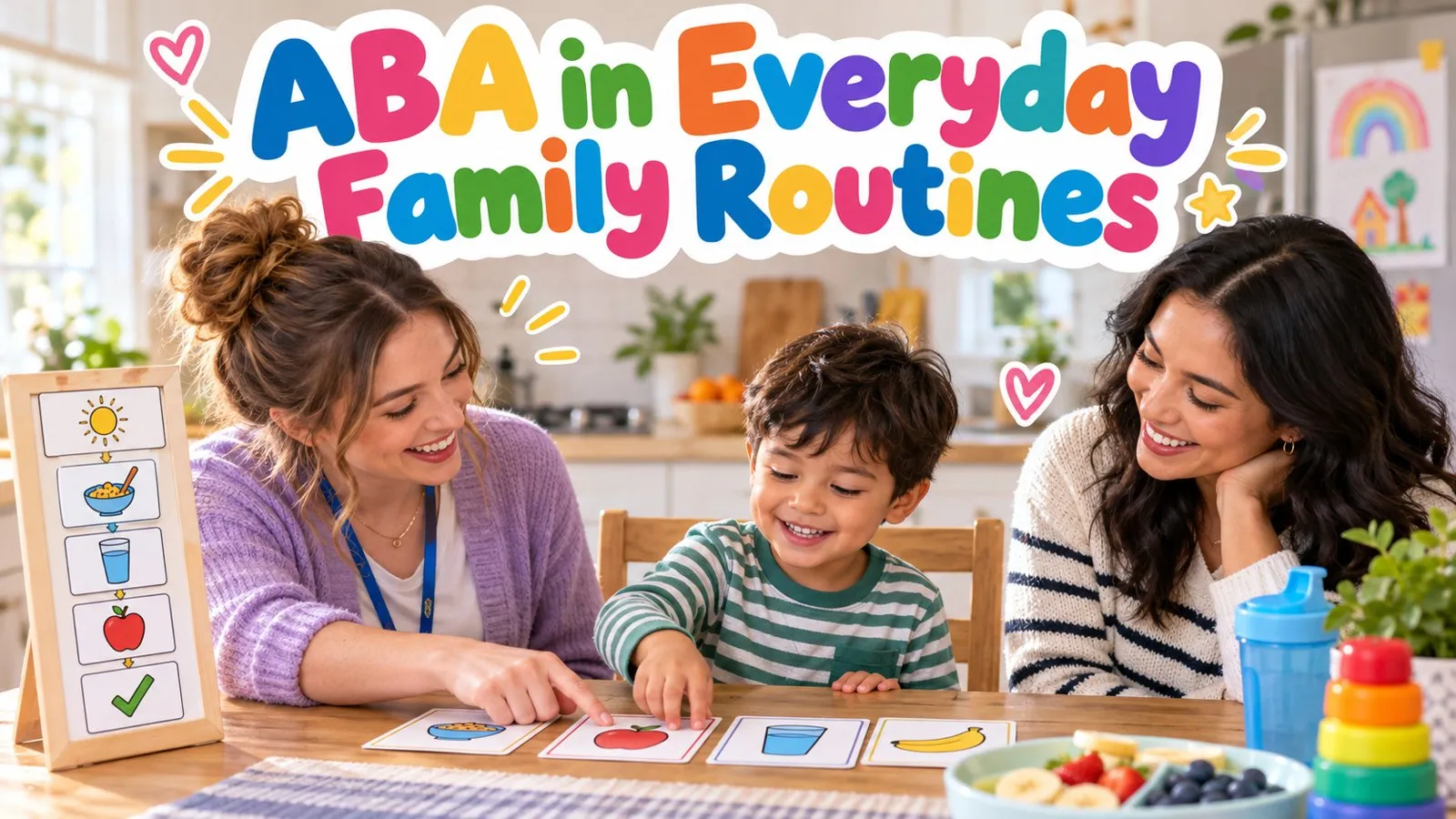
The point is not to turn your whole day into therapy. A therapist picks a few practical moments where your child is ready to learn and helps make those moments more predictable. For routine-by-routine ideas, see our guide to ABA in everyday family routines.
What is generalization, and why does home help?
Generalization means using a skill in new places, with new people, and in new situations, not just with one therapist at one table. A skill is not fully learned until it shows up in daily life.
In-home ABA gives generalization a head start. When your child learns to ask for juice in your kitchen, with your cups, and with you nearby, that request is already part of real life. Here is how home can help with common goals:
| Goal | How learning at home can help |
|---|---|
| Asking for help or items | Practiced with real snacks, toys, and family members who respond every day |
| Getting dressed | Uses your child’s own clothes, closet, and morning routine |
| Handwashing or toothbrushing | Taught at your sink, with your soap and towels, in your bathroom |
| Playing with siblings | Siblings can join sessions to practice turn-taking and sharing |
| Handling transitions | Practiced around real moments, like turning off the TV or leaving for school |
| Waiting | Built into real waits, like the microwave beeping or a sibling’s turn |
Home is still only one setting. Your child’s BCBA may plan practice at a park, a store, or with a new adult once a skill is steady. Good programs plan for this from the start.
How do parents take part in in-home ABA?
Parent participation is one of the clearest benefits of home sessions. Caregivers are there for many of the routines where skills are used, so it makes sense for them to learn the strategies too.
The NICHD describes parent-mediated therapy as an approach where parents learn techniques from professionals and use them with their own child. It notes this can provide consistent practice and support throughout the day.
In a home session, depending on the treatment plan, a therapist might:
- Show a strategy, such as waiting a few seconds for your child to ask before handing over a toy.
- Explain why it is being used and what to look for.
- Invite you to try it while they watch and give friendly feedback.
- Answer questions about what happened earlier in the week.
This does not mean you are expected to become a therapist. It means you learn a few simple, consistent ways to support communication, routines, and independence between sessions. Many families also use structured parent training alongside home sessions. Our article on supporting ABA therapy at home has more ideas for the time between visits.
Can the whole family be involved?
Families are more than one parent and one child. Brothers, sisters, grandparents, and other caregivers all shape your child’s day.
With in-home ABA, the team can include them when it fits your child’s goals. A sibling might join a board game to practice taking turns. A grandparent who helps with afternoon pickup can learn the same “first, then” phrase the therapist uses. When everyone responds in similar ways, your child gets a clearer, more consistent message.
The therapist can also suggest when a quieter session works better, such as when your child is learning something brand new.
Does the BCBA get a clearer picture of daily life at home?
When the BCBA visits your home to supervise sessions, they see your child in everyday context. They can notice what tends to happen right before a hard moment, such as a loud TV, a hungry stretch before dinner, or a crowded hallway at bedtime.
That context can make goals more practical. Instead of a general goal like “follow directions,” the plan might focus on “put shoes by the door when asked before school,” because that is the moment your family finds hardest. Your observations matter too. You see things no scheduled session can, so share them.
What about convenience and family logistics?
In-home ABA removes the drive to and from a clinic for your child. That can help families with busy schedules, younger siblings at home, or limited transportation.
It does come with its own needs:
- A space where your child can focus, even if it is just a corner of the living room.
- A parent or other responsible adult at home during sessions, in most programs.
- Some planning around siblings, visitors, pets, and screens.
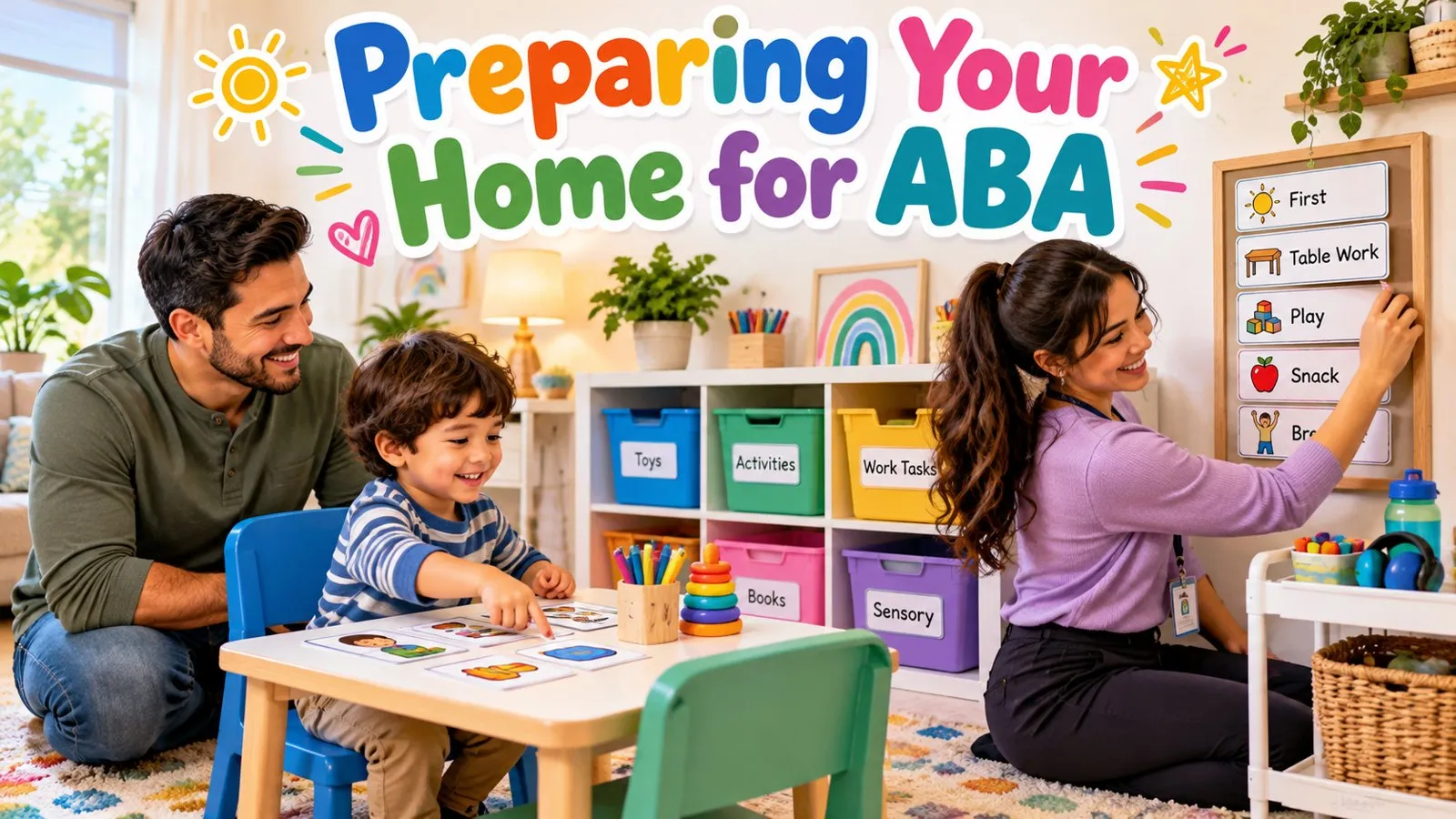
Our guide to preparing your home for ABA has a practical checklist for setting this up.
Respect and your child’s comfort come first
A good in-home program follows your child’s lead where it can, uses activities your child enjoys, and pays attention to signs that your child needs a break. Your child’s comfort and willingness to take part, often called assent, should matter in every session. You know your child best, so speak up if something does not feel right.
Every child is different. Talk with your pediatrician or a qualified professional about your child’s specific needs and which services make sense.
Talk with our team about in-home ABA
If you are wondering whether home sessions could help your child, we are happy to talk it through. United Autism Therapy offers in-home ABA therapy across Westminster and Orange County, with programs supervised by BCBAs and delivered by RBTs. We offer a free consultation to learn about your child, your routines, and your goals. Call (714) 709-7819 or contact our team whenever you are ready.
Frequently asked questions
Is in-home ABA as effective as center-based ABA?
Neither setting works best for every child. What matters most is the quality of the program, how well the goals fit your child, and how consistently skills are practiced. Your child's BCBA can explain which setting, or mix of settings, they recommend and why.
Do I need to be home during in-home ABA sessions?
Most in-home programs require a parent or another responsible adult to be home during sessions. Ask your provider about their policy before you start. Being nearby also lets you see strategies in action and ask questions right away.
Can siblings take part in in-home ABA sessions?
Often, yes, when it fits your child's goals. A brother or sister might join a game to practice turn-taking or sharing. The therapist can suggest when siblings should join and when a quieter session works better.
Will my child only learn to use skills at home?
A good program plans for skills to show up in other places too, such as at the park, a store, or school. Your child's BCBA may add practice with new people and settings once a skill is steady at home.
References
- Treatment and Intervention for Autism Spectrum Disorder — Centers for Disease Control and Prevention
- What are the treatments for autism? Parent-mediated therapy — Eunice Kennedy Shriver National Institute of Child Health and Human Development
- What are the treatments for autism? — Eunice Kennedy Shriver National Institute of Child Health and Human Development
- Board Certified Behavior Analyst (BCBA) — Behavior Analyst Certification Board
- Registered Behavior Technician (RBT) — Behavior Analyst Certification Board
This article is for general education and is not medical advice. Every child is different — please talk with your child’s pediatrician or a qualified professional about your child’s needs. Read our medical disclaimer.