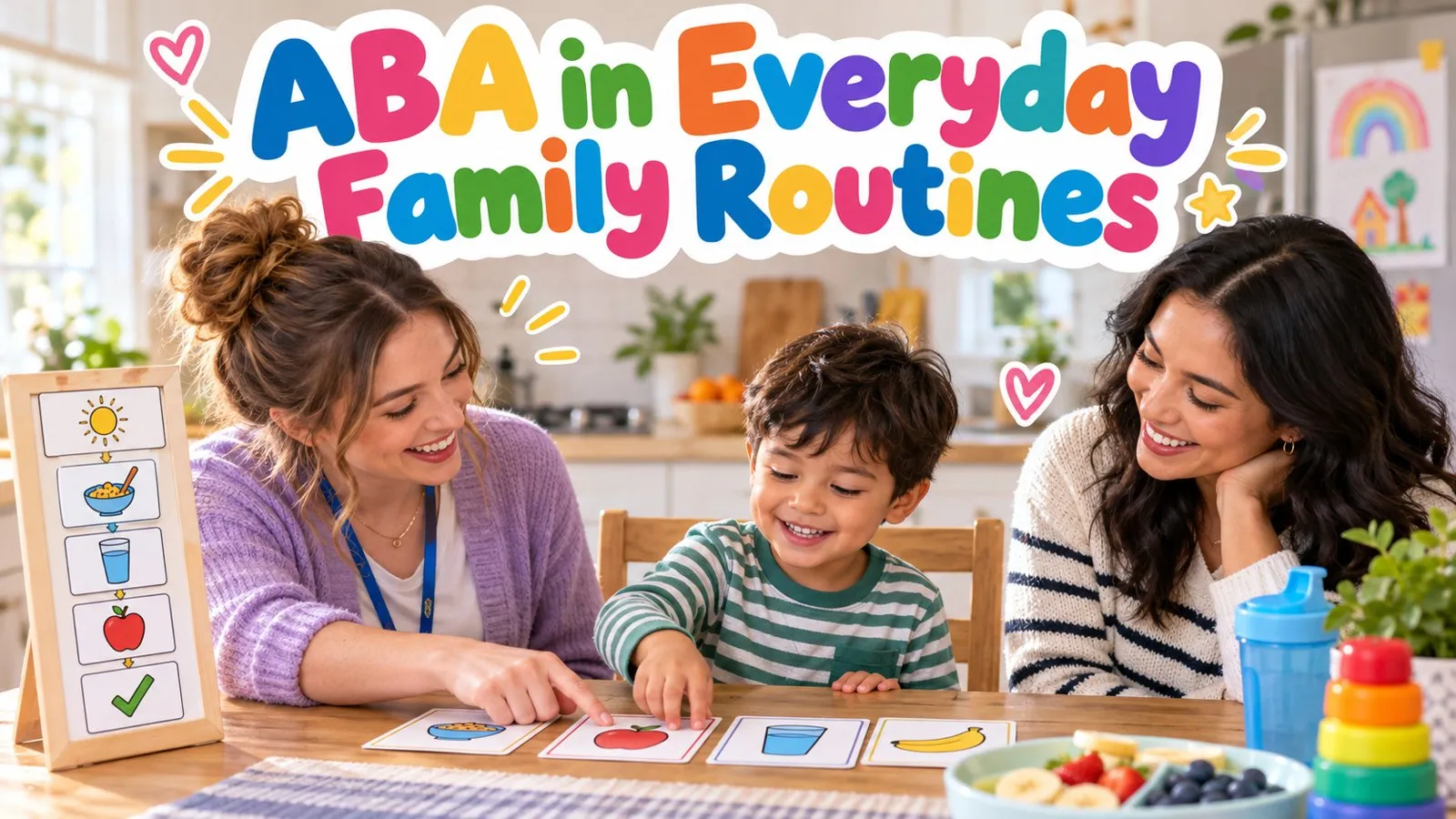
ABA in Everyday Family Routines: Mealtime, Play, Dressing and More
Quick answer
ABA in daily routines means teaching skills during the ordinary moments of family life, such as meals, play, bath time, getting dressed, moving between activities, and simple chores. In in-home ABA, a therapist picks a few of these moments, breaks the routine into small steps, and uses your child's interests to make practice meaningful. Parents learn to use the same steps so skills carry over.
ABA in daily routines means using ordinary family moments, like snack time, getting dressed, or cleaning up toys, as chances for your child to learn and practice skills. During in-home ABA, the therapist picks a few of these moments, breaks each routine into small steps, and uses your child’s interests to keep practice positive. Parents learn the same steps, so the skill keeps growing between sessions.
Key takeaways
- Everyday routines are natural teaching moments for communication, independence, and flexibility.
- The team picks a few routines that matter most to your family, not the whole day.
- Routines are broken into small, teachable steps, with help faded over time.
- Mealtime, play, hygiene, dressing, transitions, and chores can all hold meaningful goals.
- Your child’s BCBA tailors every goal to your child, and results vary.
Why are daily routines good moments to teach?
Routines happen every day, often more than once. That gives your child many chances to practice the same skill in the place it is actually used. The CDC notes that some ABA-based approaches, like Pivotal Response Training, take place in natural settings rather than a clinic. The NICHD adds that this approach works in the child’s everyday environment and focuses on skills like motivation and starting communication.
Routines also come with built-in motivation. A child who wants a snack has a reason to ask for it. A child who wants to go outside has a reason to put on shoes.
A few terms you may hear from your child’s therapist:
- Task analysis: breaking a routine into small steps, like the six or seven steps of handwashing.
- Prompt: a hint or help, such as pointing, showing, or gently guiding, that helps your child succeed.
- Prompt fading: giving a little less help over time, so your child does more on their own.
- Reinforcement: responding in a way that makes a behavior more likely to happen again. The BACB notes that ABA techniques generally teach new skills through positive reinforcement.
For more on how home sessions work in general, see the benefits of in-home ABA therapy.
How can ABA support mealtime?
Mealtime brings together sitting, waiting, communicating, and trying new things. It can also be one of the most stressful times of day.
Skills a mealtime routine can build:
- Coming to the table when called
- Sitting with the family for a few minutes, then a little longer
- Asking for food or drink using words, signs, pictures, or a device
- Saying “all done” instead of pushing the plate away
- Using a spoon or fork
- Clearing a cup or plate to the sink
What it might look like: The therapist places a favorite cracker in a clear container your child cannot open. Your child hands over a picture card or says “open,” and gets the cracker right away. Next week, the goal might be adding a word, like “open, please.”
Picky eating is common, but strong food selectivity can have sensory, medical, or oral-motor causes. If meals are a big worry, talk with your pediatrician, and read our guide to sensory processing and autism.
How does play become a learning routine?
Play is where many children feel most motivated, which makes it a strong place to teach. In-home sessions often use your child’s own toys.
Skills play can build:
- Taking turns with a ball, puzzle, or game
- Asking for “more” or “again” during a fun activity
- Copying actions, such as stacking blocks or pretending to feed a doll
- Playing next to, then with, a sibling
- Ending play and cleaning up
What it might look like: Your child loves bubbles. The therapist blows a few, then pauses with the wand ready. Your child looks, reaches, signs, or says “bubbles,” and the bubbles start again. That brief pause creates a reason to communicate without any pressure.
How can ABA help with hygiene routines?
Handwashing, toothbrushing, and bath time are multi-step routines that many families want to make smoother.
Sample handwashing task analysis:
- Turn on the water.
- Wet hands.
- Get soap.
- Rub hands together while counting or singing.
- Rinse.
- Turn off the water.
- Dry hands on the towel.
A picture strip by the sink can show each step. At first, the therapist may help with most steps. Over time, help is faded until your child does more on their own. Some children learn the last step first, called backward chaining, so they always finish with success.
If your child strongly dislikes the feel of the toothbrush or water, the plan may start with small, comfortable steps, such as simply holding the toothbrush. Your child’s comfort guides the pace.
How does ABA support getting dressed?
Dressing is a common goal because it shapes how every morning goes.
Skills a dressing routine can build:
- Choosing between two shirts
- Pulling pants up and down
- Putting on socks and shoes
- Putting a jacket on using a simple flip method
- Placing pajamas in the hamper
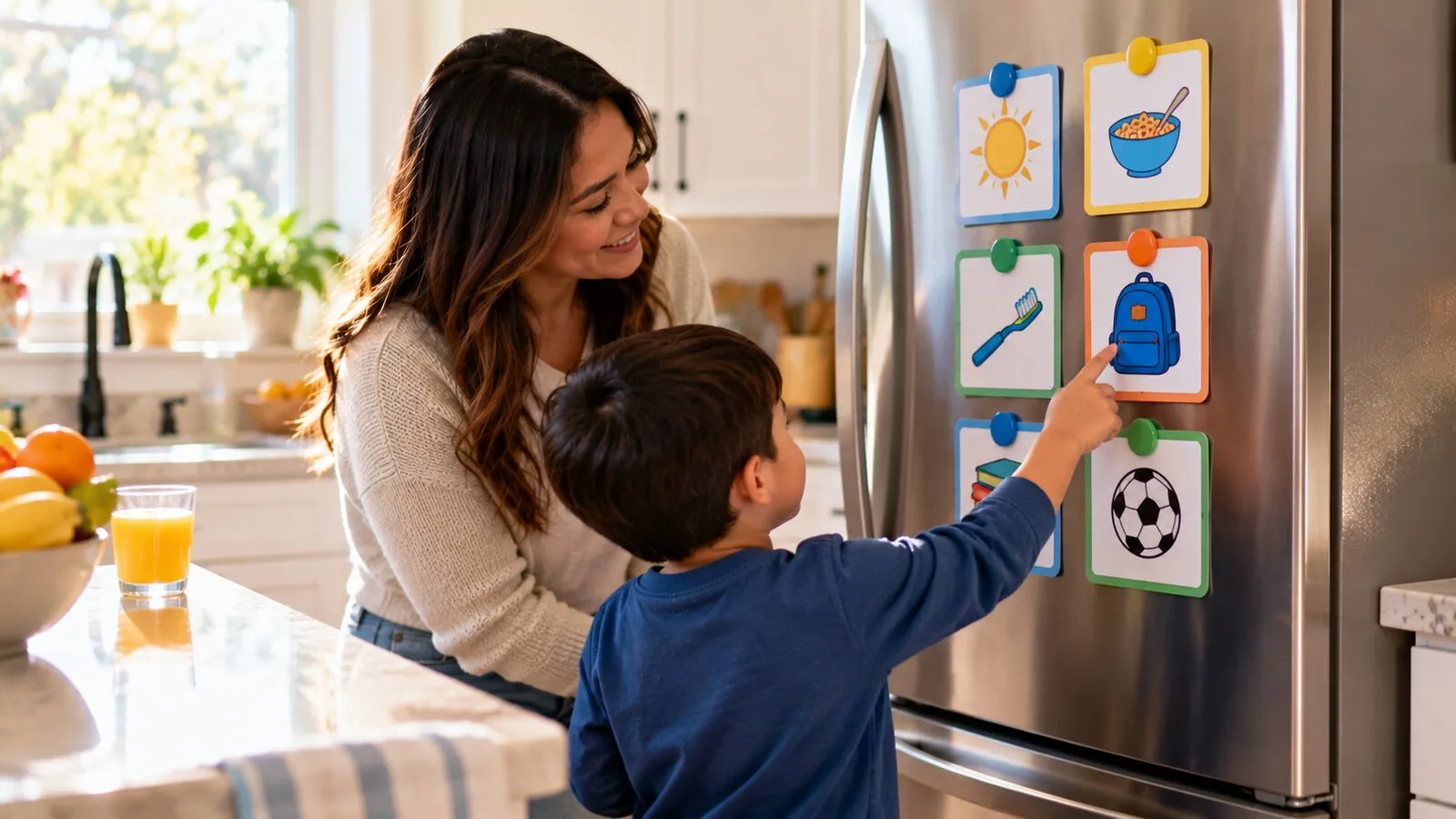
What it might look like: Clothes are laid out in order on the bed, with a picture schedule on the wall. Your child moves each picture to a “done” pocket after each item. Early on, the therapist may help pull the shirt over your child’s head, then let your child pull it down. Later, your child does both.
If buttons, zippers, or snaps are hard for your child’s hands, an occupational therapist may help too. Learn more about occupational therapy for autism.
How can ABA make transitions easier?
A transition is a move from one activity or place to another, such as turning off the tablet, leaving the park, or getting into the car. Transitions are hard for many children, especially when they are leaving something fun.
Strategies a therapist may use during transitions:
- A visual timer that shows time running out
- A short warning: “Two more minutes, then bath.”
- A “first, then” card: “First shoes, then car.”
- A transition object, like carrying a small toy to the next room
- Practicing a short, easy transition many times before a harder one
What it might look like: The therapist sets a timer during tablet time. When it rings, your child hands the tablet over and gets to pick the next activity from two picture choices. Handing over the tablet earns praise and a choice. Over time, your child may hand it over with less support.
How can household chores build independence?
Simple chores give children a real role in the family and build skills they will use for years.
Chore ideas, from simpler to more complex:
- Putting toys in a labeled bin
- Placing a cup in the sink
- Matching socks from the laundry
- Wiping the table with a cloth
- Feeding a pet with a pre-measured scoop
- Setting napkins or spoons on the table
What it might look like: Cleanup starts with one toy and one bin, with a picture on the bin. Your child drops in a single block and gets a high five. As this gets easier, the goal grows to cleaning up a whole set of blocks before the next fun activity.
Examples of daily routine goals at a glance
| Routine | Skill area | Example goal a BCBA might write |
|---|---|---|
| Mealtime | Communication | Your child asks for a preferred food using a word, sign, or picture during snack |
| Play | Social | Your child takes turns with an adult in a simple game for several turns |
| Hygiene | Daily living | Your child completes the handwashing steps with only a picture schedule for help |
| Dressing | Daily living | Your child puts on pants and socks with a small amount of help |
| Transitions | Flexibility | Your child moves from a preferred activity to the next task after a timer warning |
| Household | Independence | Your child puts toys in labeled bins before moving to a new activity |
Real goals are more specific and are based on your child’s assessment. To learn how goals are set and tracked, read how ABA therapy works.
Communication belongs in every routine
Communication is not just spoken words. The American Speech-Language-Hearing Association notes that augmentative and alternative communication (AAC) can include gestures, pictures, tablets, and other tools. If your child uses any of these, keep them close during every routine, not just during therapy. Our guide to AAC and autism explains more.
How parents keep routines going between sessions
The NICHD describes parent-mediated therapy as an approach where parents learn techniques from professionals and use them with their own child throughout the day. In-home ABA makes that learning easier, because the therapist can show you the steps right in your kitchen or bathroom.
A few simple habits help:
- Ask the therapist which one or two routines to focus on this week.
- Use the same words and picture cards the therapist uses.
- Keep it light. If your child is tired or upset, it is fine to skip practice.
- Notice and celebrate small wins, like one step done alone.
For more strategies, see our guide on supporting ABA therapy at home. Every child is different, so talk with your pediatrician or a qualified professional about your child’s specific needs.
Talk with our team about routine-based goals
If certain parts of the day feel hard, those moments are worth bringing to your child’s care team. Our in-home ABA therapy programs are BCBA-supervised and built around your family’s real routines. We offer a free consultation to talk about your child and your goals. Call (714) 709-7819 or reach out to our team to get started.
Frequently asked questions
Does ABA in daily routines mean every part of the day becomes therapy?
No. The therapist and family usually choose a few routines that matter most, often the ones that are hardest right now. The rest of the day stays family time. A few well-planned practice moments are often more useful than trying to teach all day.
Which routine should we work on first?
Many families start with the routine that causes the most stress or the one that would make the biggest difference in daily life, such as getting out the door in the morning. Your child's BCBA will also consider what your child is ready to learn and what motivates them.
What if my child is a very picky eater?
Mealtime goals in ABA often focus on skills like sitting with the family, asking for food, or tolerating a new food on the plate, at a pace your child can handle. Strong food selectivity can have sensory, medical, or oral-motor causes, so talk with your pediatrician, and ask whether a feeding or occupational therapy evaluation makes sense.
Can grandparents or babysitters use the same routine strategies?
Yes, and it often helps. When different caregivers use the same picture schedule, words, and steps, your child gets a consistent message. Ask your child's therapist for a simple one-page summary of the steps to share.
References
- Treatment and Intervention for Autism Spectrum Disorder — Centers for Disease Control and Prevention
- Behavioral Management Therapy for Autism — Eunice Kennedy Shriver National Institute of Child Health and Human Development
- What are the treatments for autism? Parent-mediated therapy — Eunice Kennedy Shriver National Institute of Child Health and Human Development
- About Behavior Analysis — Behavior Analyst Certification Board
- Autism (Autism Spectrum Disorder) — American Speech-Language-Hearing Association
This article is for general education and is not medical advice. Every child is different — please talk with your child’s pediatrician or a qualified professional about your child’s needs. Read our medical disclaimer.