How to Start In-Home ABA Therapy: A Step-by-Step Guide for Parents
Quick answer
To start in-home ABA therapy, most families follow five steps: a first consultation with a provider, an insurance benefits check and authorization, an assessment by a Board Certified Behavior Analyst (BCBA), a written treatment plan with individualized goals, and scheduling regular home sessions. A diagnosis or referral from a qualified professional is usually needed, and timelines vary by insurance plan.
To start in-home ABA therapy, most families move through five steps: a first consultation, an insurance check and authorization, an assessment by a Board Certified Behavior Analyst (BCBA), a written treatment plan, and scheduling regular home sessions. You usually need a diagnosis or referral from a qualified professional, plus your insurance information. Timelines vary by plan, but knowing the steps helps you prepare.
Key takeaways
- A free consultation is a no-pressure first step to share concerns and ask questions.
- Most insurance plans, including Medi-Cal, need a diagnosis or referral and an authorization before ABA begins.
- A BCBA assesses your child and writes an individualized treatment plan with your input.
- Sessions are scheduled around your family’s routines, usually with an adult at home.
- Gathering a few documents before your first call can save time.
The steps to start in-home ABA at a glance
| Step | What happens | What you may need |
|---|---|---|
| 1. Consultation | You share concerns, goals, and questions; the provider explains services and next steps | A list of concerns and questions |
| 2. Insurance and authorization | Benefits are checked and the plan approves an assessment, then services | Insurance card, diagnosis or referral |
| 3. Assessment | A BCBA learns your child’s strengths, needs, and routines | Past evaluations, school plans, your observations |
| 4. Treatment plan | The BCBA writes goals and recommends services; the plan may need insurance approval | Your family’s priorities |
| 5. Scheduling | Regular home sessions are set around your routines | Available days and times, a session space |
Each step is explained below. Exact steps can differ by insurance plan.
Step 1: Start with a free consultation
The first consultation is a conversation, not a commitment. It gives you a chance to explain what you see at home, ask questions, and learn whether a provider is a good fit.
A consultation may cover:
- Your child’s strengths and the challenges you see day to day
- Current routines and the parts of the day that are hardest
- Your family’s priorities and hopes
- Any past evaluations or diagnoses
- Your insurance information
- How in-home ABA works and what the next steps are
You do not need to have everything figured out. A good consultation should feel two-way. You are evaluating the provider too, so ask about qualifications, supervision, how goals are set, and how the team communicates with families. Our guide on how to choose an ABA provider has a full list of questions.
Step 2: Check insurance and get authorization
Authorization, sometimes called prior authorization, is your insurance plan’s approval for a service before it starts. ABA usually needs authorization, often first for the assessment and then for ongoing therapy.
Most plans also need a diagnosis or a recommendation from a qualified professional. The CDC notes that autism is diagnosed by trained specialists such as developmental pediatricians and child psychologists, and that there is no medical test like a blood test for it. United Autism Therapy does not diagnose autism. If your child does not have a diagnosis yet, your pediatrician is a good place to start, and our article on when to get an autism evaluation explains the process.
If your child has Medi-Cal: The California Department of Health Care Services states that Medi-Cal covers medically necessary behavioral health treatment, including ABA, for eligible members under 21. Only a physician or psychologist can determine that it is medically necessary. Members in a Medi-Cal managed care plan receive these services through their plan. In Orange County, CalOptima Health members can call the CalOptima Health Behavioral Health Line at 1-855-877-3885 (TTY 711). For details, read does Medi-Cal cover ABA therapy.
Questions to ask your insurance plan:
- Does my plan cover ABA or behavioral health treatment for my child?
- Is in-home ABA covered?
- What documents do you need, and from whom?
- Is prior authorization required for the assessment and for ongoing therapy?
- Are there limits on hours, visits, or how long an authorization lasts?
- What will my family pay, such as copays or deductibles?
Your plan is the final source for your benefits. Our team can help you understand the process; see our insurance page for more.
The Regional Center of Orange County is another local resource. It has its own intake process for children who may qualify for developmental services, including Early Start for children under 3.
Step 3: The assessment
Once the assessment is approved, a BCBA gets to know your child. The BACB describes a BCBA as a graduate-level certified practitioner who can provide behavior-analytic services and supervise RBTs.
An ABA assessment may include:
- A parent interview about your child’s history, routines, and goals
- Watching your child play and go through daily routines, often at home
- Structured activities to see which skills your child already has
- Looking at what tends to happen before and after hard moments
- Reviewing past evaluations and school plans, such as an IEP or IFSP
The assessment is not a test your child passes or fails. It is a way to understand your child as a whole person.
Step 4: Building the treatment plan
After the assessment, the BCBA writes a treatment plan. This is a document that lists your child’s goals, how they will be taught, how progress will be measured, and how many hours of therapy are recommended.
Good goals are specific and meaningful to your family. Examples might include asking for help with words or pictures, getting dressed with less support, or moving between activities with a timer warning. Many plans also include goals for parents, such as learning a strategy for a hard routine.
You should have a say in the plan. Ask the BCBA to explain each goal in plain language, and share what matters most to you. The plan is often sent to your insurance plan for approval before regular sessions begin. Goals are reviewed and updated as your child grows. To learn more about this cycle, see how ABA therapy works.
Step 5: Scheduling and your first sessions
Once services are approved, the team works with you on a regular schedule. Sessions are usually led by a Registered Behavior Technician (RBT), a certified paraprofessional who, according to the BACB, works under the direction and close supervision of a qualified supervisor. The BCBA visits to supervise, check progress, and coach your family.
When planning your schedule:
- Pick times when your child is usually rested and alert.
- Plan around naps, meals, school, and siblings’ activities.
- Make sure a parent or another responsible adult can be home, which most in-home programs require.
- Choose a consistent session spot.
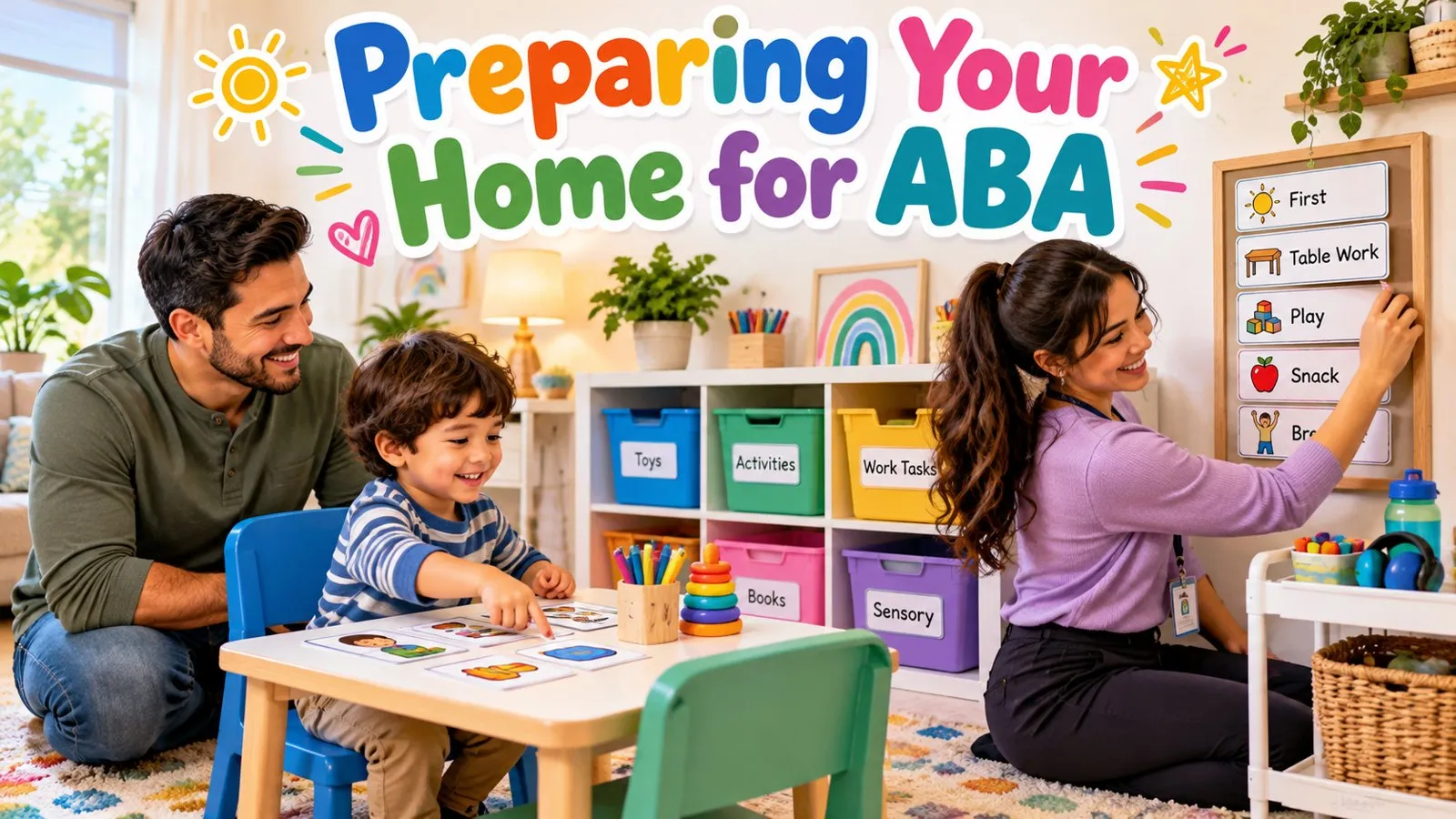
The first sessions usually focus on building trust through play. Our guide to preparing your home for ABA has a practical checklist for setup.
What to prepare for your free consultation
Having a few things ready can make your first conversation more useful.
Documents to gather, if you have them:
- Your child’s insurance card (front and back)
- Any diagnosis report or referral from a doctor or psychologist
- Past evaluations, such as speech, occupational therapy, or developmental reports
- School or early intervention plans, like an IEP or IFSP
Notes to jot down:
- Your top two or three concerns
- What a typical weekday looks like for your child
- Routines that feel hardest, like mornings or bedtime
- Your child’s favorite activities, toys, and snacks
- How your child communicates
- Days and times that could work for home sessions
Questions you might ask:
- How is the program supervised, and how often will a BCBA see my child?
- How will I be involved in sessions?
- How will you share progress with me?
- What are the next steps with my insurance plan?
Every child is different. Talk with your pediatrician or a qualified professional about your child’s specific needs.
Talk with our team when you are ready
United Autism Therapy provides in-home ABA therapy across Westminster and Orange County, with programs supervised by BCBAs and delivered by RBTs. We offer a free consultation and can help you understand coverage and authorization. Call (714) 709-7819, Monday through Saturday, 8 AM to 6 PM, or contact our team online.
Frequently asked questions
Do I need an autism diagnosis to start in-home ABA therapy?
In most cases, insurance plans require a diagnosis or a recommendation from a qualified professional before they authorize ABA. For Medi-Cal, only a physician or psychologist can determine that behavioral health treatment is medically necessary. If your child does not have a diagnosis yet, start with your pediatrician.
How long does it take to start in-home ABA?
It depends on your insurance plan, how quickly paperwork is gathered, and scheduling. Authorization steps are often the longest part. Having your documents ready for the first call can help things move more smoothly.
Is the first consultation really free?
Yes. United Autism Therapy offers a free consultation so you can share your concerns, ask questions, and learn about next steps. There is no obligation to start services.
Can we start in-home ABA if we have Medi-Cal?
Medi-Cal covers medically necessary behavioral health treatment, including ABA, for eligible members under 21. If your child is in a Medi-Cal managed care plan, services come through that plan. Our team can help you understand the steps.
Who will come to our home for sessions?
Sessions are usually led by a Registered Behavior Technician (RBT) who works under the supervision of a BCBA. The BCBA designs the treatment plan, checks progress, and meets with your family regularly.
References
- Medi-Cal Behavioral Health Treatment — California Department of Health Care Services
- Behavioral Health Services — CalOptima Health
- Screening and Diagnosis of Autism Spectrum Disorder — Centers for Disease Control and Prevention
- Board Certified Behavior Analyst (BCBA) — Behavior Analyst Certification Board
- Registered Behavior Technician (RBT) — Behavior Analyst Certification Board
- Getting Started: Am I Eligible for Services? — Regional Center of Orange County
This article is for general education and is not medical advice. Every child is different — please talk with your child’s pediatrician or a qualified professional about your child’s needs. Read our medical disclaimer.