What Age to Start ABA Therapy, From Toddlers to Teens

There is no single right age to start ABA therapy, but research suggests that starting early, often in the toddler or preschool years, gives many children the strongest foundation. Still, ABA can help at any age. School-age children and teens can build meaningful skills too, with goals that fit where they are in life.
Key takeaways
- Many children begin ABA as toddlers or preschoolers, soon after concerns come up or a diagnosis is made.
- Research links early intervention, during preschool or before, with stronger long-term results.
- ABA for toddlers is usually play-based and involves parents closely.
- Older children and teens can benefit too. It is not too late.
- There is no fixed age when ABA stops. It winds down when goals are met.
At what age is ABA most effective?
Early support tends to make a bigger difference. The National Institute of Child Health and Human Development says that early diagnosis and interventions, such as during preschool or before, are more likely to have major positive effects on symptoms and later skills.
Why does timing matter? Young children are learning at a fast pace, and skills like communication and play build on each other. Helping a toddler find a way to ask for things, for example, can open the door to many other skills later.
The American Academy of Pediatrics’ clinical report on autism guides pediatricians on identifying autism early and connecting families with intervention. And the CDC notes that by age 2, a diagnosis by an experienced professional can be considered reliable.
“Most effective early” does not mean “only effective early.” It means the sooner you get support, the more time your child has to build on it. For more on why this window matters, see our overview of early intervention for autism.
What age does ABA therapy start?
ABA can start as soon as a child has been identified as needing support and a BCBA has completed an assessment. In practice, many children start as toddlers or preschoolers.
The timeline often follows screening. The CDC reports that the AAP recommends autism-specific screening at 18 and 24 months during well-child visits. If a screening raises concerns, the next step is usually a full evaluation. Our article on when to get an autism evaluation explains that process, and our guide to the early signs of autism can help you know what to watch for.
If you have concerns about your child’s development, talk with your pediatrician. You do not need to be certain to ask.
ABA therapy by age
Here is how ABA often looks at different stages. Every child is different, so treat these as general examples.
ABA therapy for toddlers (about 18 months to 3 years)
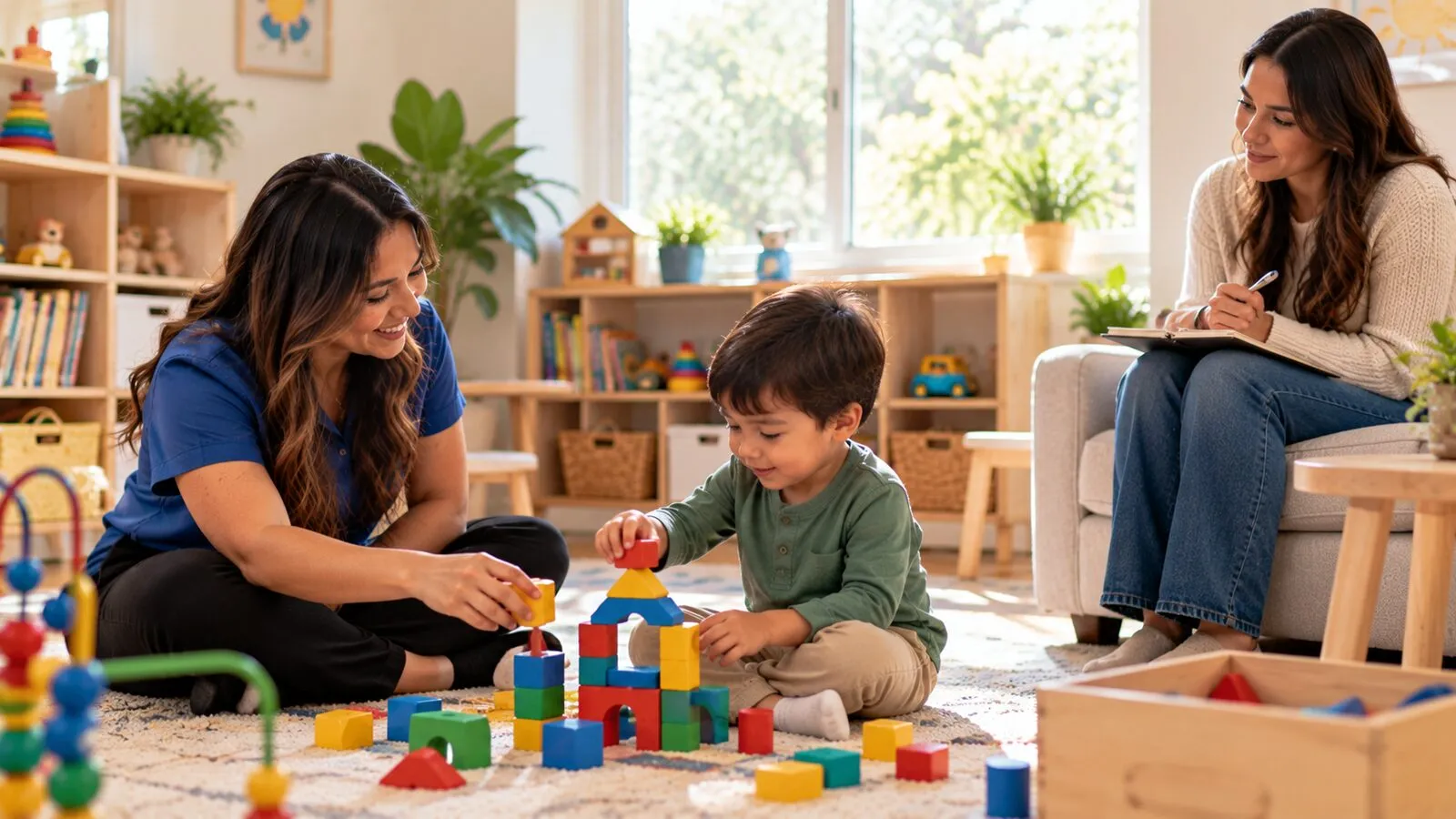
For toddlers, ABA should look a lot like play. Sessions often happen on the floor, with bubbles, songs, and toys your child already loves. Parents are usually closely involved, because so much of a toddler’s day happens with family.
Common goals at this age:
- Making requests with sounds, words, signs, or gestures.
- Imitating actions, like clapping or stacking blocks.
- Responding to their name.
- Sharing attention, such as looking at a toy together.
- Tolerating small changes in routine.
The CDC describes one play-based model, the Early Start Denver Model, as one that is used with children 12–48 months of age, where parents and therapists use play and shared attention in natural settings. You will see many of the same ideas in good toddler ABA.
A note for California families: Children from birth to age 3 with developmental delays, or who are at risk for a developmental disability, may be eligible for California’s Early Start program, run through regional centers. In Orange County, that is the Regional Center of Orange County. You can also call the Early Start BabyLine at 800-515-2229.
Preschoolers (about 3 to 5 years)
Many children start ABA in the preschool years, often right after a diagnosis. At this age, programs usually mix play with short, structured teaching.
Common goals:
- Longer requests and simple conversations.
- Play with peers, like taking turns or joining a game.
- Following group routines, such as circle time.
- Self-care skills like toileting, handwashing, and dressing.
- Getting ready for kindergarten, including sitting for short activities and moving between tasks.
Therapy may happen at a center, at home, or in a preschool setting. In-home sessions can be especially helpful at this age, because skills are practiced in your child’s everyday routines.
School-age children (about 6 to 12 years)
For school-age children, goals often shift toward independence, friendships, and handling school demands. Your child’s own preferences start to play a larger role in choosing goals.
Common goals:
- Handling transitions and unexpected changes.
- Conversation skills and understanding social situations.
- Asking for help or a break in class.
- Morning and bedtime routines with less support.
- Coping strategies for frustration or anxiety.
ABA at this age may be coordinated with your child’s school team. Our school-based ABA supports children in the classroom setting across Orange County.
Teens (about 13 to 18 years)
ABA for teens looks very different from ABA for toddlers. Teens should be active partners in choosing their goals, and their privacy and preferences matter.
Common goals:
- Life skills like cooking, laundry, shopping, and using money.
- Managing a schedule or using a phone calendar.
- Safety in the community, such as crossing streets or using public transit.
- Self-advocacy, like explaining their needs to a teacher.
- Skills for a first job or volunteer role.
Is it ever too late to start ABA?
No. If your child is 7, 12, or 16 and is just now starting ABA, there is still real value in getting support. NICHD notes that people of all ages, at all levels of ability, can often improve after well-designed interventions.
Starting later may change the goals and the style of therapy, but it does not close the door. An older child may be able to share what they want to work on, which can make therapy more focused and meaningful.
What age does ABA therapy stop?
There is no age when ABA must end. Instead, therapy usually winds down when:
- Your child has met their main goals.
- Skills are holding steady across home, school, and community.
- Your family feels confident using strategies on its own.
- Other supports, like school services or speech therapy, can meet remaining needs.
Most programs reduce hours gradually rather than stopping all at once. We explain that process in how long ABA therapy lasts.
A note on Medi-Cal coverage and age
Coverage rules can also affect timing. According to the California Department of Health Care Services, Medi-Cal covers medically necessary behavioral health treatment, including ABA, for eligible members under 21. Only a physician or psychologist can determine that these services are medically necessary. For more details, see our article on whether Medi-Cal covers ABA therapy.
What you can do while you wait
Getting an evaluation, insurance authorization, and a first session can take time. You can still support your child in the meantime.
- Ask about Early Start if your child is under 3. You can contact the Regional Center of Orange County or the Early Start BabyLine to ask about eligibility while an evaluation is still in progress.
- Track milestones. Jot down new words, gestures, and play skills as you notice them, and bring your notes to your pediatrician.
- Keep a simple log. Write down when hard moments happen, what came right before, and what helped. This is useful information for a future BCBA.
- Follow your child’s interests. Get on the floor, join their play, and give them easy chances to communicate, like pausing before handing over a favorite toy.
- Use visual routines. A few pictures showing “breakfast, shoes, car” can make mornings more predictable.
- Look after yourself. Support groups and local parent resources can help you feel less alone during the waiting period.
None of these replace professional support, but they help your child keep learning and give you useful information to share with your care team.
Signs it may be a good time to start
Whatever your child’s age, it may be worth talking to a BCBA if:
- Communication is hard and it is causing frustration.
- Daily routines like meals, sleep, or dressing are a constant struggle.
- Safety is a concern, such as running off in public places.
- Behaviors are making it hard to learn, play, or take part in family life.
- Your child’s doctor or care team has recommended behavioral support.
Talk with your pediatrician or a qualified professional about your child’s specific needs and whether ABA is a good fit.
Talk with our team
Whether your child is 2 or 15, we are glad to talk through what ABA therapy might look like at their age. Our Westminster team offers a free consultation. Call (714) 709-7819 or contact us when you are ready.
Frequently asked questions
Can a 2-year-old start ABA therapy?
Yes, many children begin ABA as toddlers. At this age, therapy is usually play-based and often involves parents closely, with goals like requesting, imitating, and joining simple games. A BCBA will assess your child and suggest a plan that fits their development.
Should we wait for an autism diagnosis before getting help?
You do not have to wait to get some kinds of support. In California, children under 3 with developmental delays or who are at risk may be eligible for Early Start through their regional center. Insurance coverage for ABA, though, usually requires a diagnosis, so it helps to pursue an evaluation and early support at the same time.
My child is 10. Is it too late for ABA?
No. ABA can support school-age children and teens, with goals that fit their age, such as handling transitions, building friendships, or becoming more independent at home. NICHD notes that people of all ages can often improve after well-designed interventions.
Does ABA end at a certain age?
There is no set age when ABA must stop. Therapy usually winds down when goals are met and your child and family no longer need that level of support. Coverage rules can also play a role. For example, Medi-Cal behavioral health treatment is for eligible members under 21.
References
- What are the treatments for autism? — Eunice Kennedy Shriver National Institute of Child Health and Human Development
- Screening for Autism Spectrum Disorder — Centers for Disease Control and Prevention
- Treatment and Intervention for Autism Spectrum Disorder — Centers for Disease Control and Prevention
- Early Start — California Department of Developmental Services
- Behavioral Health Treatment — California Department of Health Care Services
- Identification, Evaluation, and Management of Children With Autism Spectrum Disorder — American Academy of Pediatrics (Pediatrics)
This article is for general education and is not medical advice. Every child is different — please talk with your child’s pediatrician or a qualified professional about your child’s needs. Read our medical disclaimer.